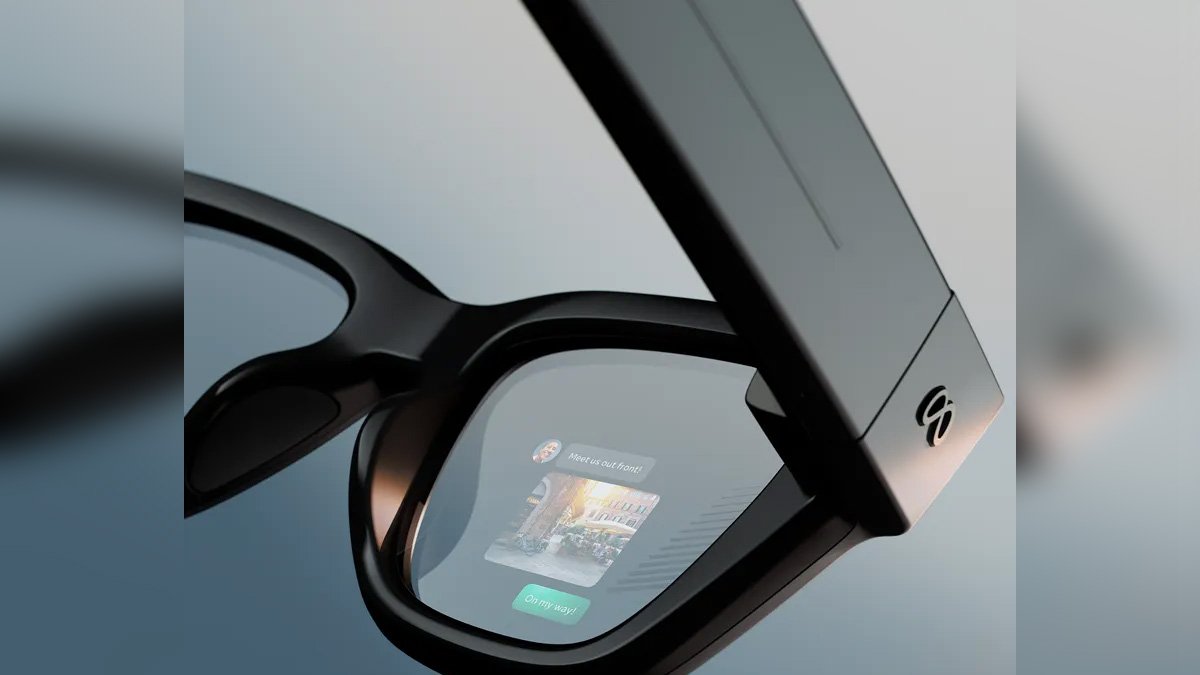
The new AI smart glasses include a heads-up display that overlays messages, captions, translations, and video calls onto the wearer’s field of view. Unlike conventional screens, this transparent display is visible only to the user and disappears when not in use. According to Zuckerberg, the innovation aims to reduce smartphone dependency while enhancing human capabilities with what Meta calls “personal superintelligence.”
Personal superintelligence and design philosophy
Zuckerberg emphasized that glasses are the ideal medium for personal AI assistants, as they allow people to remain present in the real world while accessing information seamlessly.
“Glasses are the only form factor where AI can see what you see, hear what you hear, and deliver real-time assistance right in your vision,” said Zuckerberg.
The Meta Ray-Ban Display retains the iconic Wayfarer silhouette, slightly scaled up for a modern look. The glasses feature transition lenses, transforming into sunglasses outdoors, while maintaining a lightweight and durable build.
Neural Band: a new way to control AI smart glasses
 Meta has expanded its wearable technology lineup with the launch of AI smart glasses, the Meta Ray-Ban Display, which combine artificial intelligence and augmented reality in a stylish frame. The device was unveiled by Meta CEO Mark Zuckerberg at the company’s annual Connect conference, where he described the glasses as a revolutionary step toward making AI part of everyday life.
One of the most groundbreaking features of the new AI smart glasses is the Neural Band, a wrist-worn controller that detects minute electrical signals from the wearer’s muscles. This allows users to control the glasses through subtle gestures, such as:
- Pinching fingers to navigate menus
- Twisting an imaginary knob to adjust volume
- Writing letters in the air to compose text messages
Meta describes this as the first mainstream neural interface, enabling hands-free interaction without invasive implants. The Neural Band is also accessible for people with limited mobility, expanding its usability.
Constructed from high-performance textiles with carbon-coated electrodes and reinforced with Vectran fibers, the wristband is durable, flexible, and designed for everyday use.
Functions and real-world applications
The AI smart glasses integrate a wide range of functions, including:
- Capturing photos and videos with preview options
- Live translation and real-time subtitles
- Navigation assistance with contextual reminders
- Voice and gesture-based control options
- AI-powered recommendations and memory support
During the live demo, Zuckerberg showcased how the glasses can translate conversations instantly, provide walking directions, and even summarize key reminders. Despite minor technical glitches attributed to Wi-Fi issues, the presentation highlighted the device’s real-world potential.
Competition and future adoption
Meta’s launch comes more than a decade after Google introduced Google Glass, which struggled to gain widespread adoption. However, Meta believes the technology is now mature enough to succeed.
Zuckerberg noted that adoption rates of the new AI smart glasses are tracking similarly to some of the most successful consumer electronics launches in history. He predicted that within the next decade, millions of people who already wear glasses will transition to AI-powered versions.
Industry analysts see the Neural Band as a possible replacement for traditional input devices like keyboards and touchscreens. If widely adopted, it could redefine how humans interact with computers.
Additional product announcements
Alongside the Ray-Ban Display, Meta introduced two other models at the conference:
- An upgraded version of its display-free Meta Ray-Ban glasses
- The Meta Oakley Vanguard, designed for sports and high-intensity activities
These additions reflect Meta’s strategy to diversify its wearable portfolio and appeal to both casual users and athletes.
A step toward everyday AI integration
With the launch of its AI smart glasses, Meta is pushing wearable technology into a new frontier. The combination of stylish design, practical AI functions, and neural interface controls suggests that smart glasses could soon replace smartphones as the primary way we interact with digital information.
By making advanced features accessible in a familiar form factor, Meta aims to normalize AI wearables in everyday life. If successful, this could mark the beginning of a new era in personal technology—one where artificial intelligence becomes as natural as putting on a pair of glasses.