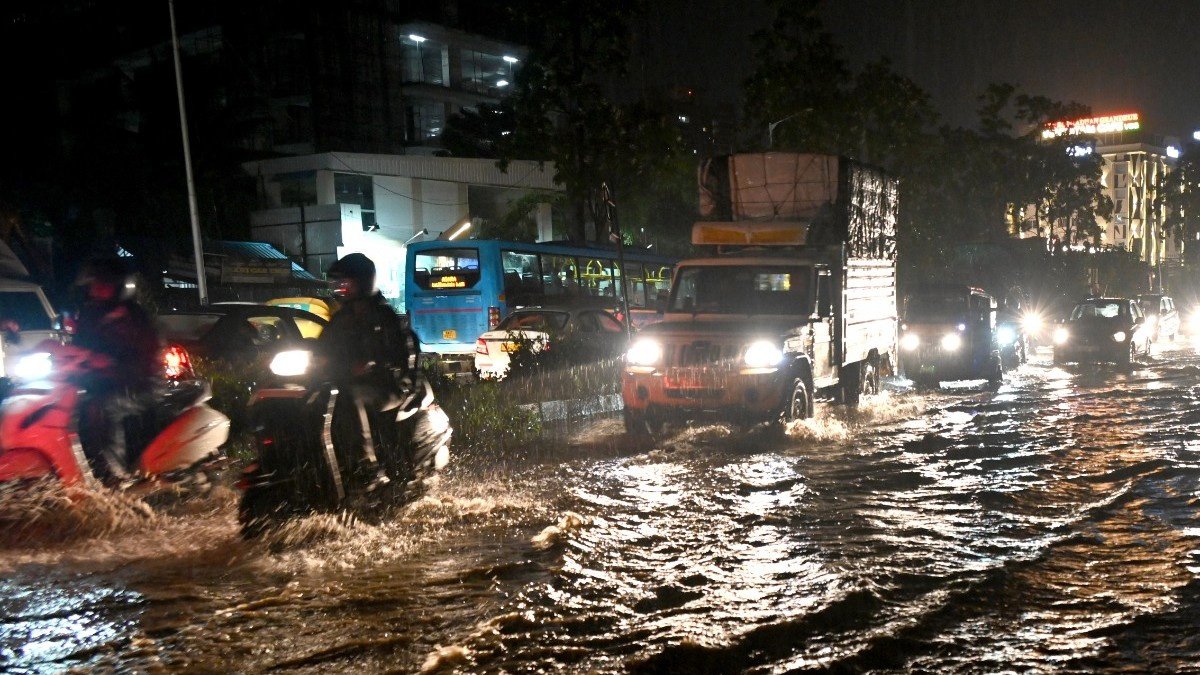
Bengaluru faced a chaotic start to the day on Friday after heavy overnight rain battered the city, causing waterlogging in several low-lying areas and traffic snarls on major roads. The downpour, which began late Thursday night, continued intermittently through Friday morning, leaving commuters and residents grappling with severe disruptions.
According to data from the city’s Automatic Weather Station (AWS), Bengaluru recorded 65.5 mm of rainfall in the last 24 hours till 5:30 am, while other nearby regions also reported significant showers. Doddaballapura received 60 mm, Chandurayanahalli in Ramanagara 46 mm, and Hessarghatta in Bengaluru Rural 43 mm.
The India Meteorological Department (IMD) has issued a yellow alert for Bengaluru, predicting light to moderate rain or thundershowers, with lightning and gusty winds reaching 30–40 kmph in isolated areas.
Widespread rainfall across Karnataka
The rain impact was not limited to Bengaluru. Several districts in Karnataka also witnessed heavy showers. The Karnataka State Natural Disaster Monitoring Centre (KSNDMC) reported that Kanagamakalapalli in Chikkaballapura district recorded the highest rainfall at 130 mm, followed by Tirumani (114 mm), Beechaganahalli (114 mm), and Chelur_1 (101 mm). In Bidar district, Bhandarkumtha logged 112 mm.
Other significant rainfall figures included Gadag at 51.9 mm, Chandurayanahalli in Ramanagara at 46 mm, Tamaka in Kolar at 21.5 mm, and Mangaluru at 20.7 mm. The Gulbarga Observatory reported instances of dry thunder in northern parts of the state.
In addition to Bengaluru, the IMD placed Vijayapura, Bidar, Kalaburagi, Tumakuru, Kolar, and Chikkaballapura under yellow alert, warning residents to stay vigilant.
IMD advisory for residents amid heavy rain
The IMD cautioned that the continuous rainfall could result in temporary power outages, waterlogging, and uprooting of weak tree branches. It issued a set of safety guidelines for residents, urging them to take necessary precautions.
The advisory included:
- Avoiding shelter under trees during thunderstorms.
- Immediately unplugging electrical and electronic appliances.
- Staying away from water bodies and objects that conduct electricity.
- Driving cautiously on slippery and waterlogged roads.
Residents were also reminded to keep emergency kits ready and remain indoors whenever possible, particularly during periods of heavy lightning activity.
Commuter woes worsen as potholes emerge
The heavy rain has exacerbated Bengaluru’s long-standing road issues, with new potholes surfacing across the city. Two-wheeler riders were particularly affected, with several reporting minor accidents caused by slippery roads and hidden craters filled with water.
Traffic movement slowed to a crawl on arterial roads like Outer Ring Road, Whitefield, and Hebbal, as vehicles struggled through flooded junctions. Officegoers faced long delays, with some commuters reporting being stuck in traffic for over an hour.
Waterlogging was reported in areas such as Koramangala, BTM Layout, HSR Layout, and parts of Bellandur, where stormwater drains were unable to handle the sudden inflow. Several underpasses in central Bengaluru were also closed temporarily due to flooding, forcing vehicles to take long detours.
Authorities step up response to rain crisis
The Bruhat Bengaluru Mahanagara Palike (BBMP) deployed emergency teams to clear clogged drains and remove fallen tree branches from roads. Officials assured that efforts were underway to restore normalcy and prevent further flooding in vulnerable zones.
Meanwhile, power supply in certain areas was disrupted for short durations due to heavy rain and lightning. Bengaluru Electricity Supply Company (BESCOM) confirmed that its teams were attending to complaints on priority and advised consumers to avoid using electrical appliances during storms.
Public concerns and repeated challenges
This latest spell of heavy rain has reignited public frustration over Bengaluru’s poor urban planning and inadequate drainage systems. Social media platforms were flooded with images and videos showing knee-deep water in residential areas, stranded vehicles, and toppled tree branches.
Urban experts argue that despite repeated warnings, unplanned urbanisation and encroachments on stormwater drains continue to worsen the city’s vulnerability to flooding. They stress that unless long-term drainage solutions are implemented, Bengaluru will remain prone to similar disruptions during every major rain spell.
The heavy rain in Bengaluru has once again exposed the city’s fragile infrastructure and the pressing need for sustainable urban planning. With IMD warning of more showers accompanied by gusty winds, residents are urged to remain alert and follow safety advisories.
While emergency teams work to mitigate the immediate challenges, the recurring issues of waterlogging, potholes, and power outages highlight the urgency for stronger civic preparedness. Bengaluru, known as India’s tech capital, must now balance its rapid urban growth with resilient infrastructure to withstand the impact of seasonal rains.